Sodium Nitrite For Food often appears as a small white crystal, yet its role in curing is far more complex. It helps preserve color, develop the familiar flavor of ham, bacon, and some sausages, and limit the growth of dangerous bacteria. Its use is carefully controlled. More is not better.
Food scientist Joseph Sebranek, professor emeritus at Iowa State University, has described nitrite as “a very important ingredient in cured meat products.” That statement reflects its practical value, but it does not end the discussion. Safety depends on the amount used, the food’s processing conditions, storage, and how often people eat cured products. Modern production also uses precise measurements, validated recipes, and monitoring systems.
The concern becomes clearer at the kitchen table. A bright pink slice of cured meat may look harmless, but repeated high consumption can contribute to a less balanced diet. Under some cooking conditions, nitrite can participate in forming nitrosamines, compounds associated with health risks. Temperature and cooking method matter. Overall dietary patterns matter more than one isolated meal.
There is no simple “safe” or “unsafe” label.
This guide examines how Sodium Nitrite For Food works, why manufacturers use it, and what regulators consider when setting limits. It also separates evidence from online fear. Some claims are exaggerated. Some reassurances are too casual. A careful reader should question both. Practical choices include checking labels, varying protein sources, avoiding heavily charred foods, and keeping cured meats occasional rather than routine.
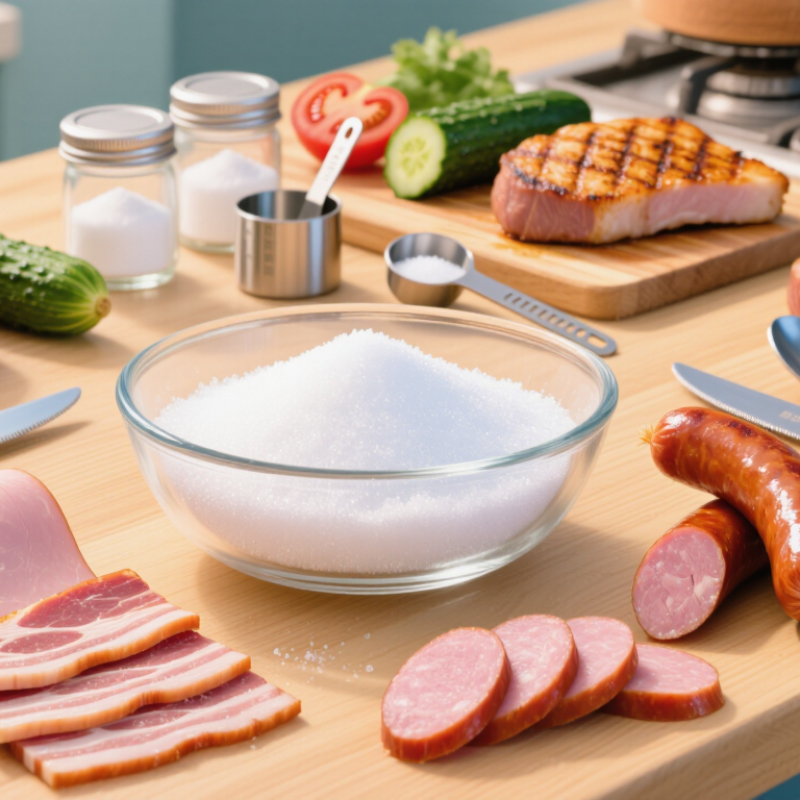
Sodium nitrite is an inorganic compound with the chemical formula NaNO₂. It appears as a white or slightly yellow crystalline powder. In food production, food-grade sodium nitrite is used in carefully measured amounts, not as an everyday seasoning. It is not table salt. Small amounts matter.
Its main role appears in cured meat products. Nitrite helps maintain the familiar pink color and contributes to the characteristic cured flavor. More importantly, it can slow the growth of dangerous bacteria, including Clostridium botulinum, when used within a controlled curing process. This function depends on accurate weighing, suitable refrigeration, and clean handling. A spoonful estimate is not reliable.
Safety requires context. Nitrite itself is regulated because excessive intake can cause harm. During high-temperature cooking, nitrite may also participate in forming nitrosamines, some of which are associated with health concerns. Food manufacturers often use carefully designed formulations and processing methods to reduce this possibility. Vitamin C compounds may support that effort, though they do not make careless handling safe. I find the chemistry useful, but the word “safe” can sound too absolute. Dose, cooking temperature, frequency of consumption, and the whole recipe all matter. Food-grade material should come from a verified source and never be confused with industrial chemicals.
| Data Dimension | Verified Information | Food-Safety Relevance |
|---|---|---|
| Chemical name | Sodium nitrite | The food-grade salt used as a regulated curing agent and preservative. |
| Chemical formula | NaNO₂ | It consists of sodium ions (Na⁺) and nitrite ions (NO₂⁻). |
| Food-additive designation | E250 in the European Union food-additive numbering system | The designation identifies sodium nitrite as an authorized additive where permitted by applicable regulations. |
| Relative molecular mass | Approximately 69.00 g/mol | This value is used when calculating concentrations and analytical measurements. |
| Nitrogen oxidation state | Nitrogen in the nitrite ion has an oxidation state of +3. | Nitrite can participate in chemical reactions that differ from nitrate, whose nitrogen oxidation state is +5. |
| Physical form | Usually a white to slightly yellow crystalline solid that is highly soluble in water. | High water solubility allows controlled distribution through curing brines and food formulations. |
| Primary food-grade role | Curing agent, preservative, and color-fixing ingredient in specified foods. | Its use is subject to legal limits, approved food categories, and manufacturing controls. |
| Protection against microorganisms | Helps inhibit the growth and toxin formation of Clostridium botulinum in suitable cured-food systems. | This is an important food-safety function, but nitrite is not a substitute for refrigeration, hygiene, or validated processing. |
| Color and flavor function | Supports the characteristic cured color and contributes to the typical flavor profile of cured meats and some other regulated foods. | The effect results from reactions involving nitrite-derived compounds and meat pigments. |
| Acceptable daily intake | The Joint FAO/WHO Expert Committee on Food Additives and the European Food Safety Authority have used an ADI of 0–0.07 mg nitrite ion per kg of body weight per day. | The ADI applies to long-term average intake and is expressed as nitrite ion, not the total mass of sodium nitrite. |
| Acute toxicity concern | Excessive ingestion can oxidize hemoglobin to methemoglobin, reducing the blood’s ability to carry oxygen. | Accidental ingestion of concentrated sodium nitrite is a medical emergency, particularly for infants and young children. |
| Potential nitrosamine formation | Under certain conditions, nitrite can react with amines to form N-nitroso compounds, some of which are carcinogenic. | Risk management includes controlled nitrite levels, approved processing methods, and measures that limit formation during cooking and storage. |
| Regulatory status | Permitted uses and maximum amounts vary by country, food category, and processing method. | Food-grade sodium nitrite must be measured accurately and used only in accordance with the relevant food regulations. |
| Overall safety conclusion | Sodium nitrite can be safe when used as an authorized food additive within regulated limits and proper manufacturing controls. | It should not be consumed directly or used as an unmeasured household ingredient; excessive exposure can be harmful. |
Note: Regulations and permitted levels differ among jurisdictions. Always follow the applicable food standard and product label instructions.
Sodium nitrite is an inorganic compound with the formula NaNO₂. It appears as white or slightly yellow crystals. It is not table salt.
It helps preserve pink color and cured flavor. It can also slow dangerous bacterial growth during controlled processing.
No. Excessive amounts can cause harm. Protection depends on accurate dosing, refrigeration, hygiene, and the complete curing method.
For many applications, 120 ppm equals 120 milligrams per kilogram of meat. It is a regulatory ceiling, not a universal recipe.
No. Use a calibrated scale and an approved procedure. A small error can change the batch significantly.
Keep them clearly labeled and separate from ordinary salt. Record batch size, nitrite amount, temperature, and curing time.
Sodium nitrite may react with other compounds during digestion or high-temperature cooking. Some resulting nitrosamines are linked with cancer concerns.
No. Research identifies a hazard, not identical personal risk. Frequency, portions, cooking temperature, diet, genetics, and smoking may matter.
Not necessarily. Occasional exposure differs from repeated consumption over many years. The evidence remains complicated.
No. Certain vitamin C compounds may help reduce nitrosamine formation. They cannot replace accurate measurement or safe processing.
Sodium Nitrite For Food is a regulated curing ingredient identified by the chemical formula NaNO₂. In food-grade applications, it helps preserve cured meats, develop characteristic color and flavor, and control the growth of Clostridium botulinum, the bacterium associated with botulism. Because nitrite levels must be carefully managed, USDA-FSIS regulations set a limit of 120 parts per million for many cured-meat applications.
Safety evaluations also consider overall dietary exposure. EFSA established an acceptable daily intake (ADI) of 0.07 mg per kilogram of body weight, providing a benchmark for assessing long-term intake. At the same time, nitrite can contribute to the formation of nitrosamines under certain conditions, and some nitrosamines are recognized as potentially harmful. The IARC has classified processed meat as carcinogenic to humans, reflecting evidence that regular consumption may increase cancer risk. Therefore, safe use depends on controlled amounts, proper processing, and moderation in dietary consumption.

 Nitro Fertilizer