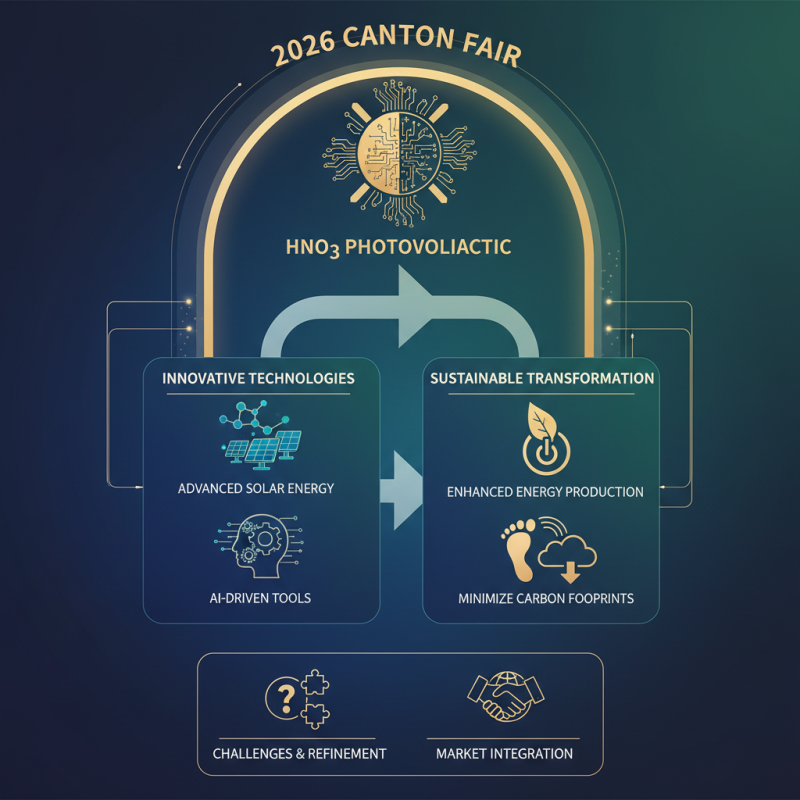
The 2026 Canton Fair will showcase innovative technologies, including Hno3 Photovoltaic solutions. Experts highlight the significant advancements in solar energy utilization. Dr. Mark Johnson, a leading figure in the Hno3 Photovoltaic industry, emphasizes, "This technology is not just about efficiency; it’s about sustainable transformation."
Attendees can expect discussions on how Hno3 Photovoltaic systems can enhance energy production and minimize carbon footprints. The fair will feature AI-driven tools that simplify sourcing and navigation. This creating a more interactive experience for participants interested in cutting-edge solutions.
The potential of Hno3 Photovoltaic is immense, yet there are challenges to overcome. Some aspects may still require refinement and better clarity. As the industry evolves, reflections on efficacy and market integration become essential. The 2026 Canton Fair presents a platform for fostering innovation while addressing these concerns.
HNO3, or nitric acid, has a unique role in photovoltaic systems. Its functionality primarily lies in the manufacturing of certain solar panel components. Certain layers within solar cells are created using HNO3. This process helps enhance efficiency and durability. A strong focus on these elements is vital as the solar industry grows.
Solar energy systems operate under specific conditions. HNO3 helps remove impurities from silicon wafers. This process can ultimately lead to better photovoltaic performance. However, there are challenges. Not all applications yield the desired results. Some processes may lead to wastage, prompting a reevaluation of methods.
At the 2026 Canton Fair, the discussion on HNO3 photovoltaic techniques will be vital. Participants will exchange insights into best practices. Reflection on the environmental impact of using HNO3 will also be necessary. Innovations should balance efficiency and sustainability. It remains crucial to explore all avenues.
| Parameter | Description | Value |
|---|---|---|
| Chemical Composition | HNO3 Photovoltaic is primarily composed of Nitric Acid (HNO3) | HNO3 |
| Functionality | Used in the manufacturing process of photovoltaic materials | Efficient material production |
| Application Area | Solar energy systems and photovoltaic cells | Renewable energy sector |
| Market Trend | Growing interest in sustainable energy solutions | Increasing demand for photovoltaic technologies |
| Advantages | Enhanced energy conversion efficiency | Higher electricity output |
: HNO3, or nitric acid, etches silicon surfaces to improve light absorption and energy conversion rates.
Improper handling of HNO3 can pose safety risks despite its performance benefits.
There is a rising demand for high-purity HNO3 as clean energy solutions gain popularity globally.
Companies may struggle to source high-quality HNO3, which can strain supply chains.
Innovations may lead to solar cells with conversion rates exceeding 25%, significantly enhancing efficiency.
The cost of production and scalability are major challenges affecting the adoption of HNO3 technologies.
Economic factors and material availability will influence fluctuations in HNO3 pricing, impacting profitability.
Expect advancements in eco-friendly processes and increased material durability, which extend cell lifespan.
Government subsidies and incentives may be crucial for small firms to implement new HNO3 innovations.
Yes, stakeholder discussions focus on environmental impact and cost-effectiveness, acknowledging both benefits and challenges.
The article explores the emerging significance of HNO3 photovoltaic technology in solar energy systems, highlighting its functionality and the critical role it plays in enhancing the efficiency and performance of photovoltaic cells. As the demand for renewable energy solutions grows, the use of HNO3 in photovoltaics is expected to increase, driven by advancements in technology and sustainability practices.
By 2026, market trends indicate a substantial evolution in the HNO3 photovoltaic sector, with notable innovations showcased at the Canton Fair. These developments promise to impact the photovoltaic industry significantly, aiding global renewable energy goals and facilitating a transition toward more efficient solar energy solutions. The article underscores the importance of HNO3 photovoltaic technology in shaping the future of sustainable energy.

 Nitro Fertilizer