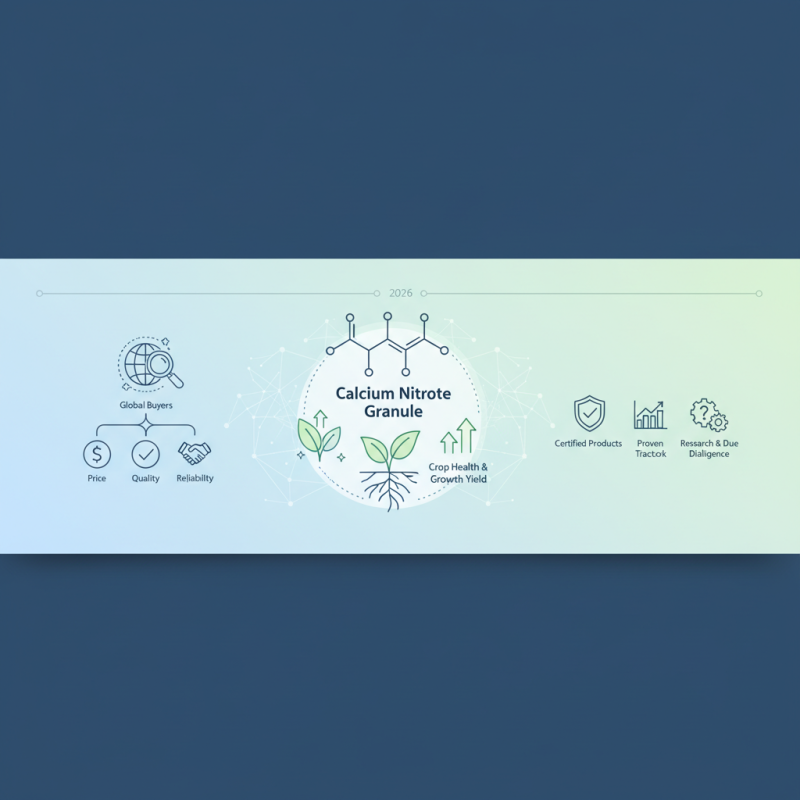
In the quest for effective fertilizers, Calcium Nitrate Granule stands out. This compound is essential for crop health and growth. It provides plants with necessary calcium and nitrogen. These nutrients enhance plant performance and yield.
Global buyers are keen on finding the best quality Calcium Nitrate Granules in 2026. The market is competitive, with various suppliers offering different grades. Understanding these options can be overwhelming. Buyers must assess not only the price but quality and reliability as well.
Consider the source of the Calcium Nitrate Granule. Does the supplier have a proven track record? Are their products certified for safety and effectiveness? These questions are crucial. Making informed decisions ensures agricultural success. It might take time and effort to research suppliers. However, these steps are vital for achieving optimal growth in crops.
Calcium nitrate granules are essential for agriculture and horticulture. They provide nitrogen and calcium, vital nutrients for plant growth. Buyers worldwide seek the best options for their specific needs. The right choice can enhance crop yield and soil quality.
When considering calcium nitrate, pay attention to the granule size. Consistent granule size ensures even distribution when applied. Larger granules dissolve slower, impacting nutrient availability. Smaller granules dissolve quickly, providing immediate nutrients to plants. This variability makes it crucial to assess the application method.
Price is not the only consideration. Quality matters significantly. Inspect sourcing and production methods. Ensure that suppliers implement quality control measures. This reflection on supply chain practices can lead to better purchasing decisions. It is vital to weigh both costs and the long-term benefits of calcium nitrate granules.
| Feature | Option 1 | Option 2 | Option 3 |
|---|---|---|---|
| Granule Size | 2-4 mm | 3-5 mm | 2-5 mm |
| Nutrient Content | 15.5% N, 19% Ca | 14% N, 20% Ca | 16% N, 18% Ca |
| Solubility | Highly soluble | Moderately soluble | Highly soluble |
| pH Level | 6.0-7.0 | 5.5-6.5 | 6.0-7.5 |
| Application | Hydroponics | Soil application | Foliar feeding |
| Packaging | 25 kg bags | 50 kg sacks | 1000 kg bulk |
When selecting calcium nitrate granules, key factors play a crucial role. Understanding nutrient content is essential. Calcium nitrate typically contains about 15.5% nitrogen and 19% calcium. This balance supports plant health and growth effectively, especially in crops like tomatoes and cucumbers. Buyers should assess the specific needs of their plants to maximize yield.
Another important factor is the granule size. Smaller granules dissolve more quickly, providing immediate nourishment. Conversely, larger granules release nutrients more gradually. Reports suggest that uniform granule size enhances application efficiency, reducing waste significantly. As global demand grows, ensuring high-quality granules that meet industry standards becomes paramount.
Additionally, sourcing and supply chain reliability cannot be overlooked. Regional availability of calcium nitrate can be affected by market fluctuations. Understanding these dynamics helps buyers make informed decisions. However, prices can vary greatly, sometimes unexpectedly, requiring careful budget planning. Balancing cost with quality ensures that agricultural practices remain sustainable while maintaining crop productivity.
In 2026, the demand for calcium nitrate granules is anticipated to grow significantly. This growth stems from its vital role in agriculture and horticulture. Various global suppliers are adapting their production to meet this need.
Top suppliers are often evaluated based on reliability and distribution capabilities. They must ensure timely delivery and consistent product quality. Many companies are focusing on sustainability practices. This shift aims to reduce environmental impact while ensuring product safety. However, challenges such as fluctuating raw material costs can affect pricing and availability.
Buyers should consider local supplier options too. Regional suppliers may offer quicker shipments and lower freight costs. Evaluating supplier credentials ensures credibility. Understanding regional differences in product formulations can also lead to better agricultural results. The market for calcium nitrate continues to evolve, offering both opportunities and challenges for buyers.
The demand for calcium nitrate granules is rising globally, driven by various market trends. Fertilizer demand is a key factor. According to a recent report by Research and Markets, the global fertilizer market is projected to reach $300 billion by 2026. This surge in demand influences calcium nitrate sales positively. Farmers are increasingly adopting calcium nitrate for its benefits in crop yield and soil health.
Sustainability trends are also shaping the market. Many buyers seek environmentally friendly products. Calcium nitrate is considered a sustainable option due to its efficient nitrogen utilization. The International Fertilizer Association reports that this compound improves both nitrogen absorption and water efficiency in crops. As more agricultural players adopt sustainable practices, calcium nitrate granule demand is expected to grow.
Economic factors can't be overlooked. Global supply chain disruptions have affected the availability and pricing of agricultural inputs. Fluctuations in raw material costs are a concern. A recent study by MarketWatch highlighted that prices for fertilizers could vary significantly based on global economic conditions. This unpredictability might lead farmers to reconsider their purchasing strategies for calcium nitrate granules.
Calcium nitrate is widely used in agriculture as a nitrogen source. However, its production raises concerns about environmental sustainability. The process typically involves reacting nitric acid with calcium carbonate, generating CO2 as a byproduct. Reports indicate that calcium nitrate production could contribute approximately 0.1% of global CO2 emissions. This figure may seem small, but in an era of climate urgency, every bit counts.
Sustainable practices in the calcium nitrate industry are essential. Utilizing renewable energy sources can significantly reduce emissions during production. Some studies suggest that if manufacturers switch to solar or wind energy, emissions could drop by up to 30%. This shift not only helps combat climate change but also fosters long-term viability for the industry.
Water usage is another concern. For every ton of calcium nitrate produced, around 3,000 liters of water is consumed. Efficient water management strategies could mitigate this impact. Innovations in production processes may offer alternatives. However, challenges remain in balancing production demands with sustainability practices. Continuous research is critical for finding solutions that benefit both agriculture and the environment.
: Understanding nutrient content is vital. Calcium nitrate generally contains 15.5% nitrogen and 19% calcium.
Smaller granules dissolve quickly, offering immediate nourishment. Larger ones provide nutrients gradually.
Uniform size enhances efficiency, reducing waste. It leads to better distribution during application.
Market fluctuations can impact regional availability. Buyers need to be aware of these dynamics.
Prices can change unexpectedly, requiring careful budget planning. Balancing cost and quality is crucial.
Production generates CO2, contributing roughly 0.1% of global emissions. Every bit counts in climate efforts.
Utilizing renewable energy sources, like solar or wind, can cut emissions by up to 30%.
About 3,000 liters of water is consumed for every ton produced. Efficient management strategies are needed.
Balancing production demands with sustainable practices remains complex. Continuous research is essential for progress.
The article delves into the diverse options available for buyers seeking Calcium Nitrate Granules in 2026, providing a comprehensive overview of their benefits and applications. Key factors such as purity, solubility, and granule size are highlighted as crucial considerations when selecting the right product. Furthermore, it explores the top global suppliers, emphasizing their role in meeting the increasing demand for this essential agricultural nutrient.
The discussion also examines current market trends affecting Calcium Nitrate Granule sales worldwide, alongside the sustainability issues related to its production. As environmental concerns grow, the industry is moving toward more sustainable practices, underscoring the need for buyers to consider both effectiveness and ecological impact in their purchasing decisions. Overall, Calcium Nitrate Granule remains a vital component in modern agriculture, with its market continuing to evolve in response to global needs and sustainability initiatives.

Nitro Fertilizer